
Cash on delivery is shrinking. The refused order isn’t.
Cards are winning in Saudi Arabia and the UAE. The COD orders that remain are the ones that come back, and most of that is decided before the driver knocks.
By Moustafa Othman
41% → 20%
MENA preference for cash on delivery, 2020 to 2023
Checkout.com, 2024
85%
of Saudi retail payments were electronic in 2025
SAMA, 2026
26% vs 2%
COD vs prepaid orders returned to origin
Shipway, India, FY25
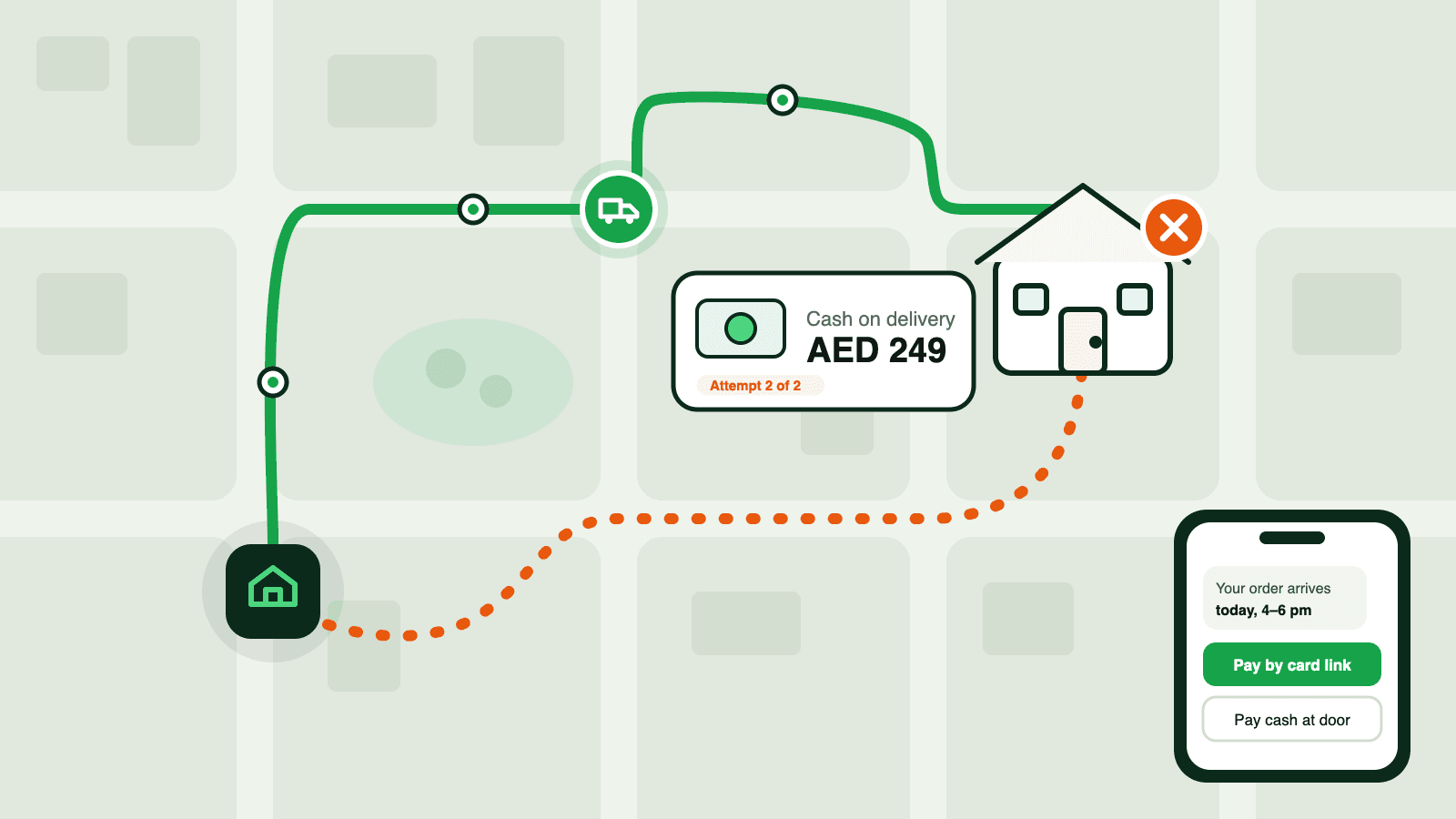
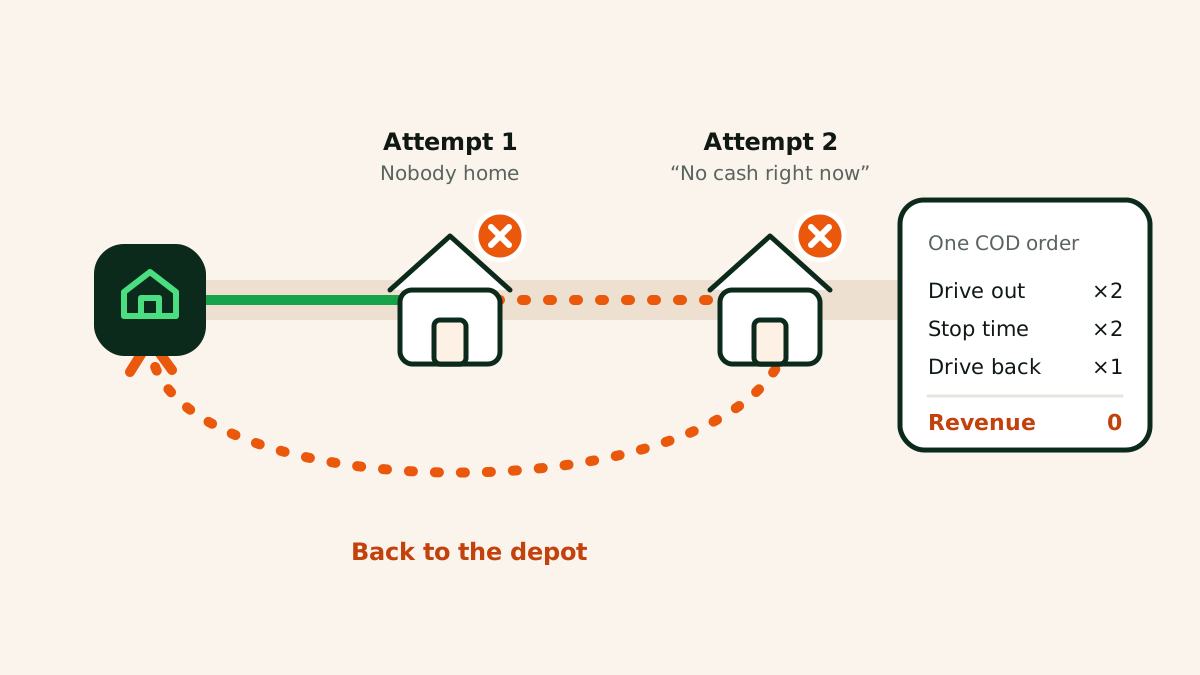
The driver rings twice. Nobody answers, or someone does and says they do not have the cash right now. The parcel goes back on the van, rides around for the rest of the shift, and comes home to the depot. Tomorrow it goes out again, or it goes back to the merchant.
Nobody logs that as an operations failure. It shows up as a “refused” status, a return fee, and a cash total that does not match. But most of what decides whether a cash-on-delivery order is paid or comes back happens before the driver knocks: which day it went out, which window was promised, whether the address was right, and whether anyone asked the customer first.
COD is shrinking. It is not gone.
The direction is clear. Checkout.com’s 2024 MENA report found preference for cash on delivery across the region halved, from 41% in 2020 to 20% in 2023, and as low as 10% in Saudi Arabia, the UAE and Kuwait. Its 2025 edition, built on more than 1,000 consumers each in Saudi Arabia, the UAE and Egypt, put the fall in COD usage since 2020 at 64% in Saudi Arabia and 53% in the UAE.
The wider payment data agrees. Saudi Arabia’s central bank reported electronic payments at 79% of retail payments in 2024 and 85% in 2025. That covers all retail, not just ecommerce, but it is a long way from 2021, when a Tamara co-founder put COD at 60 to 70 per cent of Saudi online orders.
So why write about COD at all? Because the orders still on it are not a random sample. They tend to be first orders, unfamiliar shops, and people who want to see the parcel before they pay. Checkout.com found 74% of UAE consumers would pay by card if COD were not offered. The rest are the buyers a driver meets at the door with a parcel and no payment yet.
The cost lands at the door
Here the Gulf has a data problem. There is no regulator-published refusal or return rate for COD in the UAE or Saudi Arabia. The figures that circulate are mostly old company estimates. In 2020, the Saudi parcel-locker firm FODEL told Arab News that delivery failure rates could be as high as 40%. That is one company’s number, not a market measure.
The clearest measured data comes from India, which runs a similar mix of COD and prepaid orders at much larger volume. Shipway’s analysis of its FY25 shipments, reported in July 2025, found 26% of COD orders were returned to origin, against less than 2% of prepaid orders. It is a different market, and the Gulf rate may well be different. The gap between the two payment types is the part worth taking seriously.
Every returned COD order is paid for twice in driving and stop time, once more to bring it back, and sometimes again to send it to the merchant. The revenue on it is zero.
Every day you wait, the odds get worse
The most useful line in the Shipway data is about time. Orders first attempted within one to two days came back 22% of the time. At three to five days, 27%. After five days, 35%.
That fits what any dispatcher already knows. A buyer who ordered on impulse and paid nothing up front has a few days of intent. After that, the parcel competes with a cheaper listing, a different shop, or simply second thoughts. A plan that pushes COD stops to tomorrow because today’s vans are full is not neutral. It is quietly raising the refusal rate.
22%
Returned when first attempted in 1–2 days
Shipway, India, FY25
27%
Returned when first attempted in 3–5 days
Shipway, India, FY25
35%
Returned when first attempted after 5 days
Shipway, India, FY25
Most misses start with an address or a window
Not every failed COD stop is a change of heart. A lot of them never reach the customer at all. In a 2021 survey of retailers in the US, UK and Germany, GBG/Loqate found that when addresses were inaccurate or incomplete, 41% of deliveries were delayed and 39% failed.
The region is treating this as infrastructure. Saudi Arabia’s Transport General Authority ruled that from 1 January 2026, parcel companies may not accept or carry a shipment without a National Address, partly to cut unnecessary calls between couriers and recipients. Dubai is replacing street signs and house plates across 186 areas by 2030, with Makani numbers and QR codes on the new plates.
The window matters as much as the pin. A customer told “today” plans nothing. A customer told 4–6 pm can be home, and can have the cash ready. Promising a window the sequence can keep is a COD tactic, not only a tracking one.
Confirm before you load the van
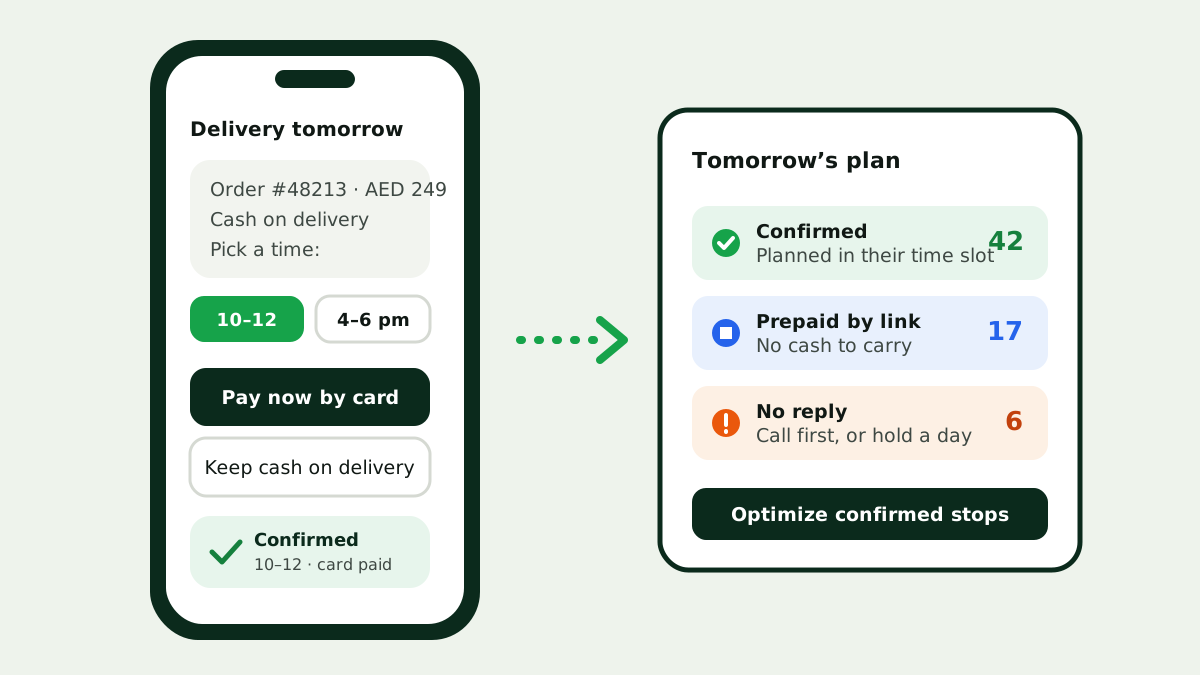
The cheapest COD attempt is the one you do not make. A message the evening before, asking the customer to confirm, pick a slot, or pay now, sorts tomorrow’s stops into three groups: confirmed, paid, and silent. Confirmed and paid stops go into the plan. Silent ones get a call or wait a day.
We could not find an independent study that measures how much this reduces refusals. The published numbers come from the vendors who sell the messaging, so we are not quoting them. The logic does not need a percentage: a refusal you learn about at 8 pm costs a message. The same refusal at 3 pm costs a drive.
The same message is also the moment to move the payment off cash. Tamara says its instalment option helps lower COD transactions by up to 30%; treat that as the provider’s own figure. An older Visa and Dubai DED survey, from 2019, found 92% of UAE shoppers who preferred COD would pay by card if a card machine came to the door. Either way, a payment link before arrival or a card reader at the door turns a cash stop into a normal one.
Close out the cash, not just the route
A delivered COD order is not finished until the money is in the merchant’s account. That cycle is slow. One UAE courier, Jeebly, describes remitting COD seven days after collection, with riders reconciling over the first five. Cash also costs something to handle: back in 2021, talabat UAE added a cash-handling fee as cash volumes rose.
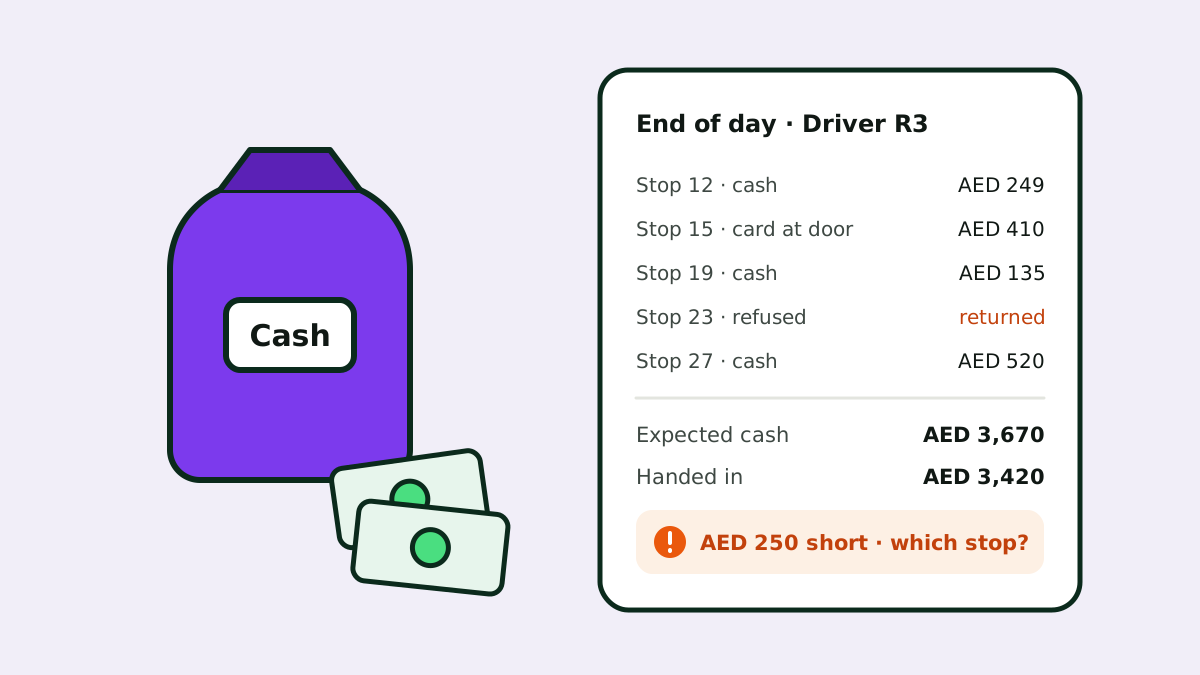
Most of that week is spent finding mismatches. A driver hands in AED 3,420 against AED 3,670 expected, and someone has to work out which stop was short, which was paid by card, and which was refused. If the driver app records the amount, the method and a photo at each stop, the end-of-day total is a sum, not an investigation.
What to change in the plan
- Attempt COD orders first. Every day of delay raises the chance they come back.
- Confirm the evening before, and plan only confirmed or paid stops into tight windows.
- Offer a payment link in the same message, and a card reader at the door.
- Fix the address before dispatch: a pin, a Makani number or a National Address, not a building name.
- Record amount, method and proof at every stop, and reconcile by driver the same day.
- Measure your own refusal and return rates by zone, time slot and payment type. The region does not publish them, so your numbers are the only ones that count.
Sources
- Checkout.com, State of Digital Commerce in MENA 2024, press release, 14 May 2024. Link · UAE figures via Khaleej Times, 15 May 2024. Link
- Checkout.com, State of Digital Commerce in MENA 2025 (1,000+ consumers each in Saudi Arabia, UAE, Egypt), via Consultancy-me.com, 3 June 2025. Link
- Saudi Central Bank (SAMA) e-payment share of retail payments: 2024 via Arab News, 15 April 2025; 2025 via Sharikat Mubasher, 14 April 2026. 2024 · 2025
- Gulf Business, Tamara co-founder on Saudi COD share, 20 May 2021. Link
- Shipway ShipNotes, FY25 RTO analysis (India), via MediaInfoline, July 2025. Link
- Arab News, FODEL on Saudi delivery failure rates, 14 December 2020. Link
- GBG/Loqate, Fixing Failed Deliveries (US, UK, Germany), via InternetRetailing, 4 March 2021. Link
- Okaz, Transport General Authority National Address requirement for parcels, 11 December 2025 (Arabic). Link
- Gulf News, Dubai street signs and house plates for 186 areas by 2030, 7 October 2026. Link
- Visa and Dubai DED survey, via Khaleej Times, 19 May 2019. Link
- Amazon Payment Services, Tamara (figures as reported by Tamara). Link
- Jeebly, “How Jeebly ensures secure COD delivery in the UAE,” 28 November 2025. Link
- Gulf News, talabat UAE on cashless payments, 29 August 2021. Link
If you want to see COD collection, proof of delivery and end-of-day cash by driver in one place, book a walkthrough.
Book a walkthrough