

Operations
“Where is my order?” starts before the van leaves
The ticket sits in customer service. The cause is usually a delivery promise the morning plan could not keep.
Moustafa Othman · 17 September 2026 · 9 min
15%
of ecommerce CS calls are “where is my order?”
Narvar
66%
hit a delivery problem in the last three months
Descartes / SAPIO, 2025
90%
want a late alert and a new ETA
AlixPartners, 2026
The call usually starts the same way. Someone was given a window. The window passed. Nobody said anything. Now they want a person, not another status email.
Support logs it as WISMO — “Where is my order?” Narvar has called it the number-one question in ecommerce, about 15% of customer-service calls, at up to $6 a contact. That figure is a few years old, and the dollar cost moves with wages and channel. The shape of the problem has not.
The ticket lands in CX. The cause usually does not.

People will wait. They will not be surprised.
McKinsey’s work on US ecommerce deliveries is blunt: arriving when you said you would matters more than arriving fast. About half of respondents track a shipment to check it is still on time. Roughly 85% do not treat an order as unacceptably late if it lands within one or two days of what they were told.
That is the opposite of how a lot of last-mile desks still sell the day. The plan is built to look tight. The tracking page shows a clock the morning sequence cannot keep once traffic, a long stop, or a mid-day add shows up. The customer is not angry that the van took forty minutes. They are angry that 2:00–4:00 became 6:15 with no word.
AlixPartners’ 2026 Home Delivery Survey put a harder edge on it. More than 85% of consumers said a poor delivery reduced their willingness to buy again. Nearly 90% said a late delivery at least weakens the relationship even if the retailer apologises. What they want instead: an explanation, and a new ETA. More than half said they would boycott after one or two missed deliveries.
FarEye’s June 2022 US survey of about 1,000 consumers found 85% would not shop that retailer again after a bad delivery. Tracking and visibility sat next to speed and cost in how people defined a good one.
Two in three consumers hit a delivery problem in three months. That share has barely moved since 2022.
Descartes + SAPIO Research, 8,000 consumers in Europe and North America, 2025.
Descartes and SAPIO asked 8,000 people in early 2025. Sixty-six percent had a delivery problem in the previous three months — 79% of under-35s. In the full study, that overall rate was 67% in 2024, 69% in 2023, and 66% in 2022. The desks got a little better. The customers did not feel it.
Forty-one percent of all respondents named at least one negative delivery factor as a reason not to buy more online. Among under-35s it was 47%. That is the growth cohort, and they are the ones Descartes found least satisfied.
The support queue is the bill for that.
The number on the page was already wrong
WISMO is often treated as a tracking-page problem. Put a map on a link and the calls should fall. Some of them do. They do not if the time on that page was fiction.
WISMOlabs looked at about 2.6 million valid deliveries across 140 retailers. The median retailer had a carrier ETA on 80.8% of those deliveries. Matching the exact calendar date: 61.8%. Matching within a day either side: 83.2%. An exact date is a stronger claim than the underlying signal often supports.
That work is parcel-carrier ETAs, not a private fleet’s stop-by-stop plan. The lesson still holds for anyone who puts a clock on a customer’s phone. A smaller Descartes / Indago survey of operators found only 5% calculated ETAs from live GPS. Most still used standard lead times.
If the morning plan uses empty-road drive times and a flat five minutes a stop, the first tracking message is already a lie. The agent who picks up at 4:40 is answering a question the planner created at 8:10.

Then nobody told them it moved
AlixPartners asked both sides. In the 2026 report, 90% of consumers said it matters to be told when a delivery will be late, and to get the updated ETA. They want that at the first sign of trouble. Fifty percent of executives wait until the delay is certain to hit the date.
That gap is the second engine: silence. The customer refreshes. The same window is still there. Then they call.
Sixty-eight percent of those executives put ETA accuracy as their top AI use case for the next two to three years. Live tracking and proactive delay notices were what consumers asked for. The alignment is rare. The habit is still to wait.
90%
Want a late alert and a new ETA
AlixPartners, 2026
50%
Of executives wait until the delay is certain
AlixPartners, 2026
5%
Of operators in one survey used live GPS for ETAs
Descartes / Indago
The next ticket is “I never got it”
When the window was wrong and the update never came, the third contact is a dispute. InPost UK’s 2026 research, reported by Retail Gazette, put first-attempt failure at one in three parcels, with shoppers spending 5.5 hours a month waiting or fixing misses. That is a UK parcel-network finding, not a universal rate. The mechanism is familiar anywhere: the recipient planned around a window, left, and the bag is now a claim.
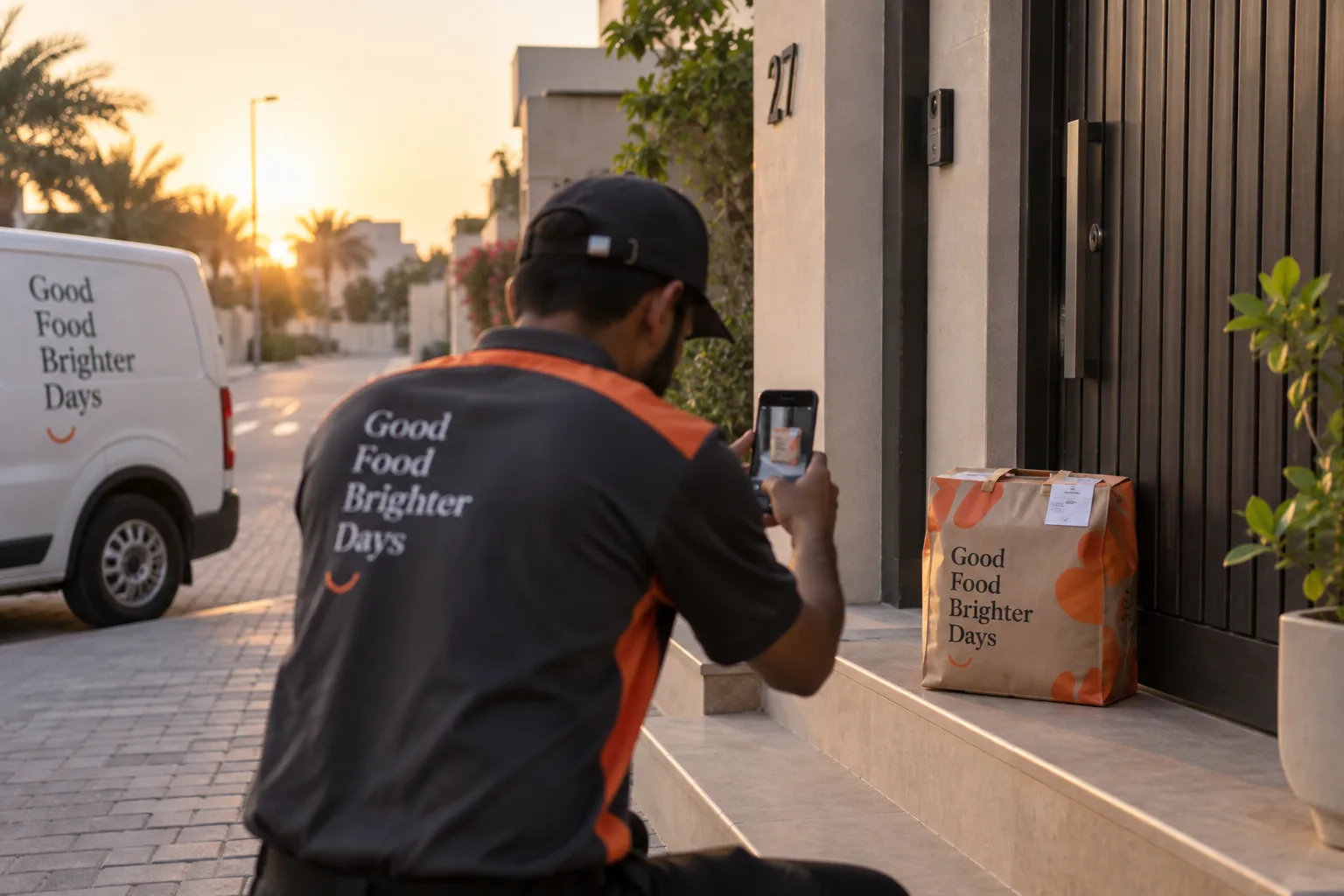
A photo at the door does not undo a late arrival. It stops the next twenty minutes on the phone about whether it arrived at all.
What to change in the plan
If WISMO is an ops cost, the levers are in the morning, not in the helpdesk script.
- Promise only a window the sequence can keep — real stop times, traffic at that hour, not an empty-road guess.
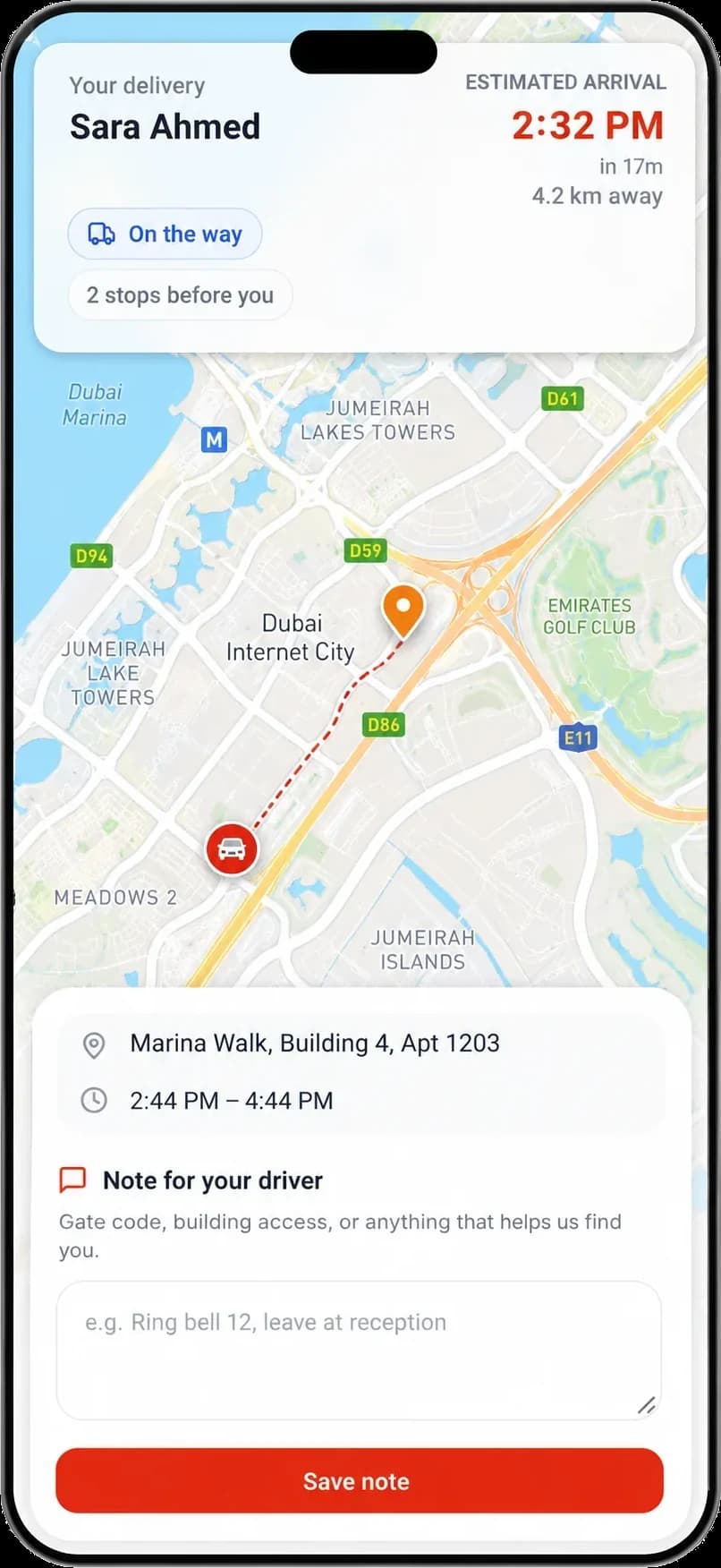
- Recalculate when the day moves, and tell the customer before they notice.
- Give them a link they can refresh without a person.
- Close the stop with proof the office and the customer can both see.
None of that is a chatbot. AlixPartners found three in five shoppers have used an AI bot for tracking. That helps after the fact. It does not fix a plan that was never going to arrive at 2pm.
Sources
- Narvar, “3 Steps to Eliminate WISMO and WISMR” (2022, updated 2026). Link
- McKinsey & Company, “What do US consumers want from e-commerce deliveries?” Link
- Descartes + SAPIO Research, “How Smarter Home Delivery Wins Younger Consumers as Online Buying Slows,” 2025 (8,000 consumers, Europe and North America). News · PDF
- Descartes / Indago, “Customer Engagement: The Missed Opportunity in Delivery.” Link
- AlixPartners, Great Expectations: 2026 Home Delivery Survey (fielded 28 April–4 May 2026). Press · PDF
- FarEye Last Mile Mandate Consumer Survey, June 2022 (~1,000 US consumers), via Business Wire. Link
- WISMOlabs, “When an ETA is not a promise” (~2.6 million deliveries, 140 retailers). Link
- InPost UK research, reported by Retail Gazette, March 2026. Link
If you want to see tracking, proof of delivery, and the live plan on the same day, book a walkthrough.